Pricing your cleaning services wrong is the fastest way to stay busy and broke at the same time.
It’s the number one reason that cleaning businesses go out of business.
The good news is that while you will have to do some testing in your local market, pricing for cleaning services has mostly been figured out, so I can give you a really good starting point in this guide.
Here's how to build a price that actually holds up.
Start By Calculating Your Real Cost Per Clean
Before you set a single price, you need to know what it costs you to show up and do the job.
Your cost per clean has five components:
-
Labor: Your hourly rate or your employee's wage, plus payroll taxes. If you're the one cleaning, your time has a cost even if you're not paying yourself a formal wage yet.
-
Supplies and equipment: Cleaning products, microfiber cloths, mop heads, vacuum bags. A rough rule of thumb is $4-8 per clean for a well-stocked, regularly restocked kit.
-
Transportation: Gas and vehicle wear. At the IRS standard mileage rate, a 15-mile round trip costs roughly $10.
-
Overhead: Insurance, software, advertising, and admin time. Divide your monthly fixed costs by your number of jobs to get a per-clean overhead figure.
-
Profit margin: Not optional. Build in at least 20-30% on top of your total costs. This covers slow weeks, broken equipment, callbacks, and the fact that you're running a business, not just doing a job. It’s also a good starting point to give you a bit of a buffer while you’re dialing in prices.
Here's what that looks like in practice...
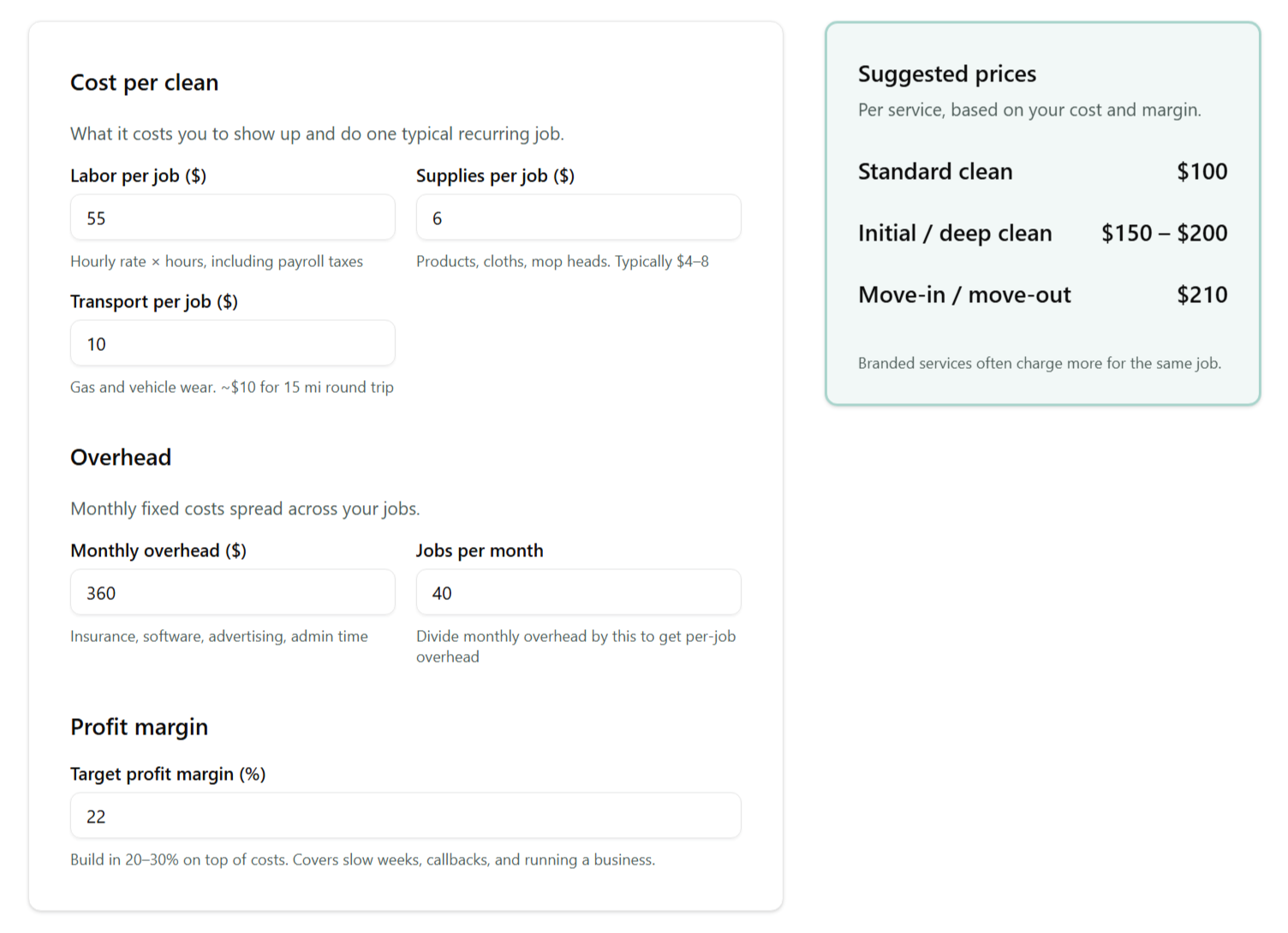
A two-hour recurring clean might cost you $55 in labor, $6 in supplies, $10 in transport, and $9 in overhead. That's $80 in real costs. At a 25% margin, your minimum viable price is $100. Anything below that and you're subsidizing your client's clean home.
(Afterwards, you can use our free cleaning service price calculator to get a quick estimate of what your service prices should be.)
How to Not Feel Like You’re Overcharging
I completely understand the feeling like you’re not trying to overcharge someone because you think you’ll get complaints.
But by pricing too low, you typically get the worst clients who only care about price and will complain a ton and constantly ask for discounts. And it’s really hard to raise prices for these people in the future.
Instead, don’t compete on price.
Compete on reputation, niche, or a certain offering (i.e. late night cleans or we don’t need much notice for appointments, etc.).
A branded service with 50+ five-star cleaning reviews, professional uniforms, and an online booking page can charge $160-200 for the same job, and clients will pay it because everything they see signals competence and reliability.
Now you can actually provide value to customers beyond just a basic cleaning job where you compete on price (customers value more than just the job itself).
How to Price Different Types of Cleaning Jobs
Not every clean is the same job. Your pricing structure should reflect that, and it doesn't need to be complicated to be effective.
-
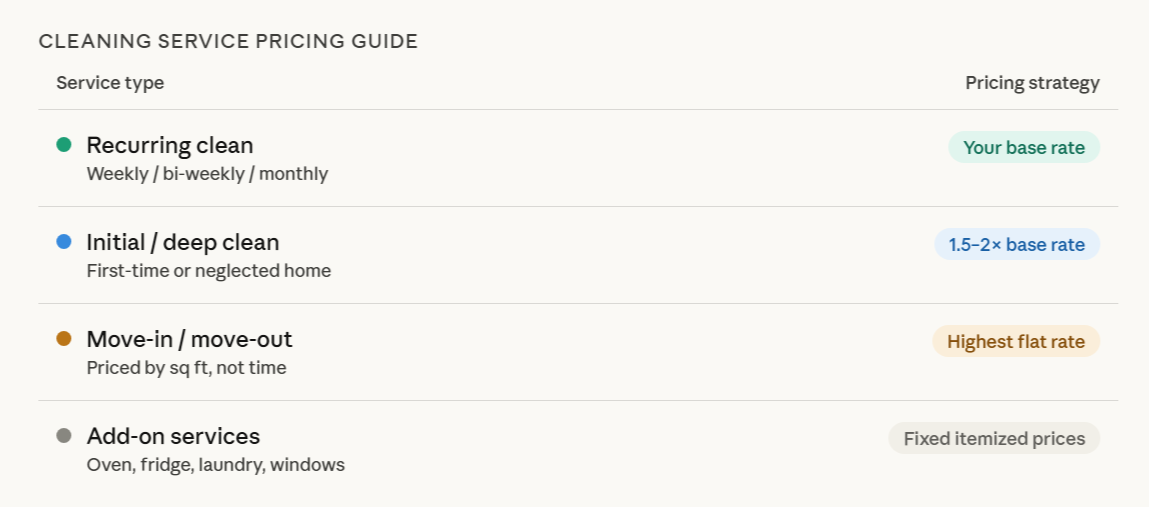
Standard recurring clean: Your base flat rate, priced for a well-maintained home on a regular schedule. This is your core revenue and should be priced to be repeatable and profitable, not discounted to retain clients who'd leave anyway.
-
Initial or first-time deep clean: Charge 1.5 to 2 times your recurring rate. A home that hasn't been professionally cleaned in a year takes significantly more time and product. Charging your standard rate for this job is how you lose money on your best new clients.
-
Move-in/move-out clean: Your highest-rate service. These jobs require cleaning inside appliances, cabinets, baseboards, and areas that get ignored during regular maintenance. Price them at a flat rate based on square footage, not time, so you're not penalized for having an efficient team.
-
Add-on services: Inside oven, inside fridge, laundry, window cleaning. Itemize these separately with fixed add-on prices so clients can customize without forcing you to renegotiate the whole job. See our post on cleaning add-on ideas if you need help.
A simple version of this pricing ladder might look like: recurring 2-bed/1-bath at $130, initial deep clean at $220, move-out at $280, with add-ons ranging from $25 to $50 each. These numbers will vary by market, but the ratios should hold.
Hourly vs. Flat Rate: Why Flat Rate Wins for Residential Work
The debate between hourly and flat rate occupies too much space in cleaning business forums. Here's the short version: flat rate is better for most residential work, most of the time.
Hourly Pricing Punishes You for Getting Better
When you charge by the hour, you earn less as your team gets faster and more skilled. That's a backwards incentive structure that actively works against investing in training and systems.
It also creates anxiety for clients who watch the clock while someone scrubs their bathroom, uncertain whether the bill will be two hours or three.
Hourly pricing makes sense for initial deep cleans on genuinely unpredictable homes, where the scope is hard to assess in advance. For everything else, it caps your upside and introduces friction you don't need.
Flat Rate Rewards Efficiency and Builds Client Trust
Flat rate gives clients certainty and gives you control over your margins. When your team gets faster at a recurring client's home, your effective hourly rate goes up without a single conversation about pricing. That's the system working the way it should.
The key to flat rate that most people miss: build in a buffer. If a job should take two hours, quote for 2.25 to 2.5. That buffer covers the week the client forgot to mention they have three dogs, or the bathroom that needs extra attention. If a job consistently runs over your quote, raise the price at the next billing cycle. Don't absorb it.
Pricing Mistakes That Kill Your Margins
Most cleaning businesses don't have a sales problem. They have a pricing problem that looks like a sales problem, because the jobs they're winning aren't profitable enough to matter.
Dropping Your Price to Win the Job
If a prospect tells you they have someone cheaper, dropping your price is the worst move you can make. Here's what actually happens: you quote $140, they say they have someone at $110. You agree to $120. You've just signaled that your prices are negotiable, trained this client to push back every time, and committed to doing the job for $20 less than you decided you needed. Some clients will always choose the cheapest option. Those are not great clients to have.
Leaving Recurring Prices Frozen
Your costs go up every year. Supplies, labor, insurance, fuel: all of it increases. If you haven't raised prices on clients you've had for two or three years, you're now making less in real terms than when you started.
A 5-10% annual increase is reasonable, predictable, and expected by any client who's ever paid for any service in their life. Send a short notice 30-60 days in advance. Don't apologize for it.
Quoting Without Enough Information
Blind quotes over the phone are guesses with a dollar sign in front of them. A three-bedroom house can take two hours or five depending on pets, clutter, and how long it's been since someone cleaned it properly.
Before you quote, use a short intake form or do a quick walkthrough for bigger places to get the real picture. A quote based on actual information is a price you can stand behind.
How Consistent Quoting Protects Your Pricing
One underrated pricing problem is inconsistency. When you quote manually, from memory, you introduce variability. The same job gets priced differently depending on how busy you are, how confident you feel, or whether you were distracted when the inquiry came in. Over time, that inconsistency erodes your margins and confuses clients who refer friends and quote them a different number.
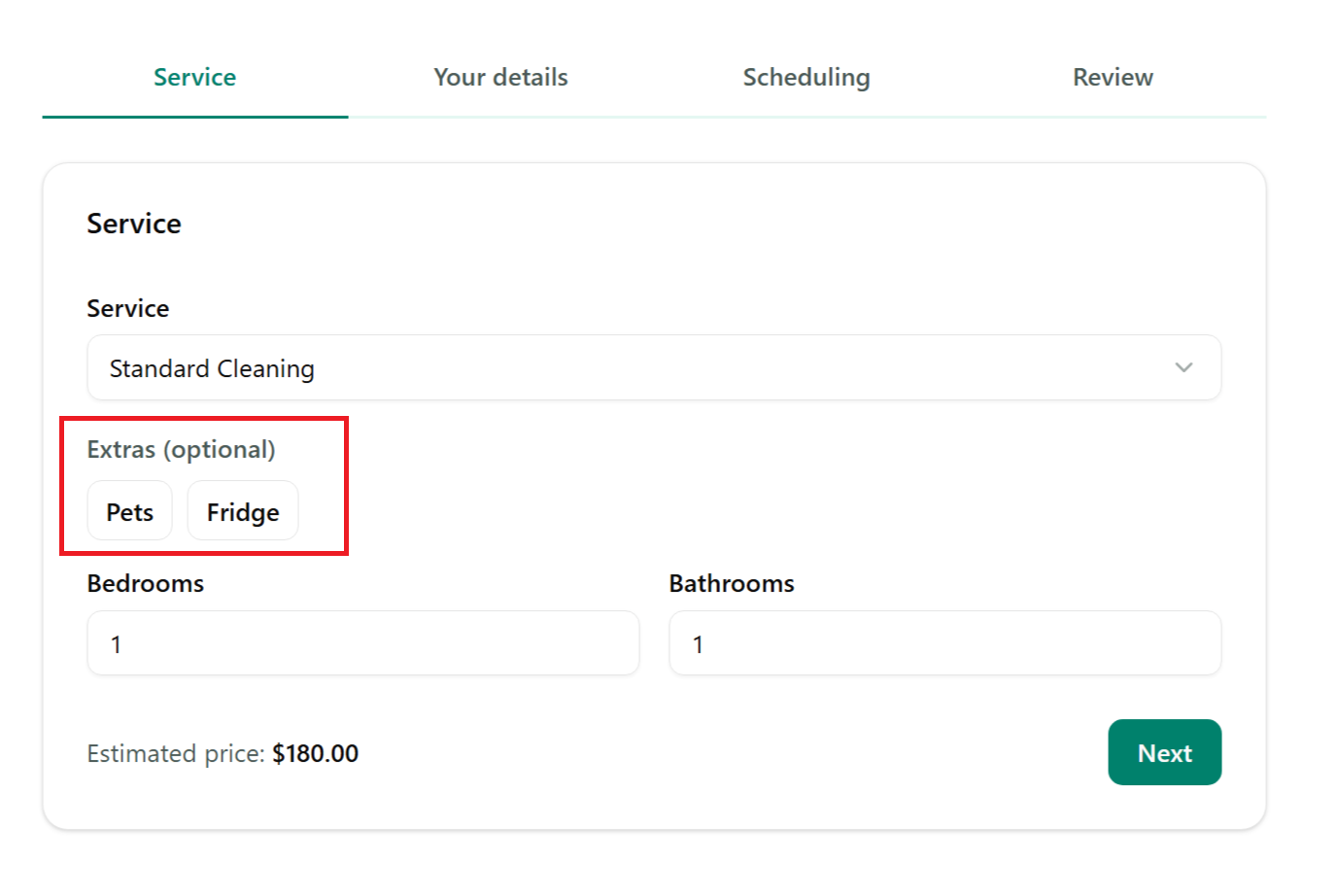
Automating the quoting process removes that variability. Tools like CleanSlot let you build your pricing rules once and generate consistent quotes automatically, so a three-bed/two-bath always comes out the same, add-ons are priced correctly every time, and nothing falls through the cracks because someone forgot to follow up.
When your pricing system is consistent, it's also easier to raise prices across the board, because you're adjusting rules, not rewriting every quote manually.
Key Takeaways
Pricing isn't a number you set once. It's a system you build and maintain.
-
Start with real costs, not competitor rates. Know your floor before you set your price.
-
Use flat rate for recurring residential work. Hourly pricing caps your earnings and creates client anxiety.
-
Price different job types differently. An initial deep clean should never be quoted at your recurring rate.
-
Raise prices annually. Your costs increase every year. Your rates should too.
-
Quote with information, not guesses. A walkthrough or detailed intake form protects you from jobs that bleed money.